



Articles
Abs/Back: What Does it All Mean?
April 10, 2014
April 10, 2014
I rarely prescribe specific ab work to my lifters. More often I prescribe specific back work, but there are many times when I write something like “abs/back” on a lifter’s program. This is not code for “go home” as my wife always believed when our coach, Mike Burgener, wrote it on her program. It’s an expectation that the athlete knows what he or she should be doing and will take the initiative to do it. Admittedly, this is an expectation that often leads to disappointment. Because most of the online programs I post on the Catalyst Athletics website don’t have prescribed ab and back work, yet the program info page instructs athletes to perform it daily, I’m going to try to lay out clearly what exactly my expectations are, and my preferences for how it’s done.
Back Work
First, there is plenty of back work inherent in training for Olympic weightlifting: squatting and pulling and the lifts themselves place quite a demand on the back. However, for many (if not most) lifters, additional direct back training is a good idea if not necessary.
I break back work into two basic categories: heavy and light (these names are accurate representations of the stunning creativity I have in this area). But let me explain what I mean:
Heavy
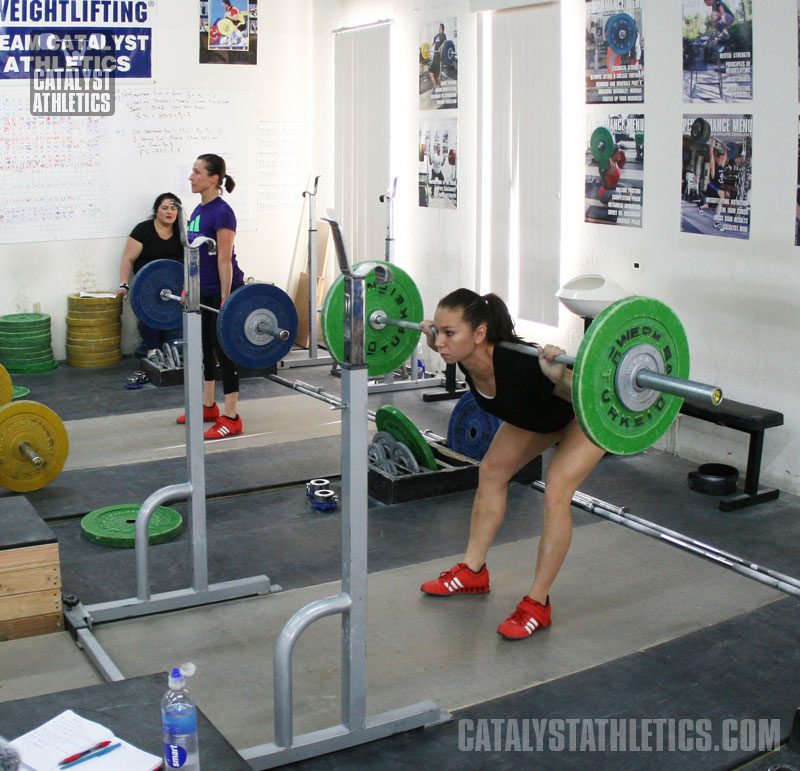
·Stiff-legged deadlifts
·Straight-legged deadlifts
·Good mornings
Light
·Back extensions
·Back planks
·Reverse hypers
·Glute-ham raise
Heavy back work is something I would account for in the training volume of the program—it has a significant effect on the lifter’s recovery. These are exercises I’m going to prescribe in a program, and probably only 2-3 days each week. Light back work would not be considered in that count, and won’t have much of an effect in terms of systemic fatigue. I will sometimes prescribe these exercises specifically, but not always. These can be done daily, and it’s common for me to tell an athlete with a weak back arch in the lifts to do back extensions every training day.
I prefer to do heavy back work on the heavier training days and leave unweighted work for the lighter days, although this isn’t a hard rule. There are times when I will do stiff-legged deadlifts or good mornings on the lighter days if it works best for the program and I find that lifter recovers well enough from them to not cause problems on the heavy days that follow.
Ab Work
There is a lot more variety with ab work than back work, and there are no ab exercises I would consider to be part of the total training volume of the program. I break ab work down into different categories:
Trunk/Hip Flexion
·Sit-ups
·Hanging Leg Raises (and knee raises)
·Crunches
·Reverse Crunches
·Glute-ham bench (roman chair) sit-ups
·Jack knives
·V-ups
Static
·Planks (front/side)
·Hollow rocks and variations
·Ab Wheel
Rotation
·Russian Twists
·Standing Twists
·Windshield Wipers
There are plenty more exercises than what I have listed here, but these are the ones I find most effective. Others may get thrown in occasionally just for some variety, but I’ll always fall back on these.
I prefer an alternation of tougher/larger range of motion exercises with easier, static or rotation exercises. For example, on the heavier days of the week (usually Monday, Wednesday and Saturday for my lifters), I like to do a trunk/hip flexion exercises, possibly weighted, and then either an unweighted, higher volume different trunk/hip flexion exercise, or a static/rotation exercise. Then on the lighter days (Tuesday and Thursday for my lifters), static and/or rotation exercises. So a week might look something like this:
Monday
·Hanging leg raise
·V-ups
Tuesday
·Plank
·Standing twist
Wednesday
·Hanging leg raise
·Sit-ups
Thursday
·Plank
·Russian twists
Saturday
·Weighted sit-ups
·Jack Knives
For unweighted ab work, I typically use 10-30+ reps, and 8-15 reps for weighted work. For planks, I will usually stick between 20-30 seconds and add weight as needed.
When to do What with Whom
So when do you use more taxing back work, when do you use only light back work, and when you do prescribe ab and back work for a lifter, and when do you leave them to their own devices?
First, you prescribe specific work to any lifter you find doesn’t do what they need to be doing on their own. The more guidance a lifter needs, the more you need to provide—pretty simple. If you tell a lifter to go do some ab work, and they spend 20 minutes lying on the floor looking at Twitter and do 5 sit-ups, that lifter is the perfect candidate for spelling it out in the program.
Second, you prescribe specific work when there is specific need. That is, if a lifter is generally stable when he or she lifts, they don’t have a need for a ton of ab and back work. If ab and back strength is lacking, you need to prescribe it to shore up the weakness. The bigger the weakness, the more the training—more weakness means more need for the heavier back work and greater volume of ab work.
Finally, if a lifter has very limited training time, they may require a very pared-down program overall, in which case all the extra work goes out the window and they’ll need to rely on just the basics to get by. This doesn’t mean ab and back work isn’t important, it just means it’s less important than snatches, clean & jerks and squats.
And Remember…
“I don’t need to do ab work, I stabilize my midline during the lifts,” is something lazy people say when they need an excuse to not do more work. It’s not accessory work, it’s successory work.