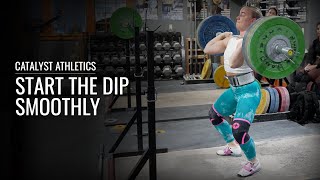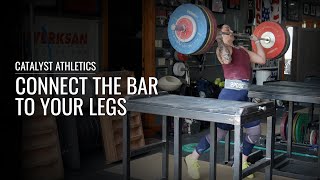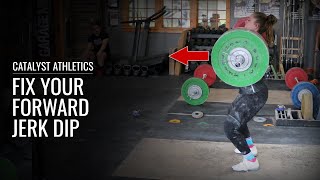



Why A Vertical Dip in the Jerk - Knees Only, No Hips
There’s a lot of resistance to the idea of bending the knees only for the jerk dip because athletes tend to believe the hips have to contribute, so let me explain why this is critical, and clear up some confusing points.
The jerk motion is like a piston driving the bar up. This position is already somewhat precarious, so hinging forward at the hip very quickly creates two big problems:
More difficulty keeping the bar secure in the rack, which means less force transfer from the legs, misdirecting it forward, and pushing early with the arms, further reducing bar acceleration;
And the more you lean forward, the harder it becomes to stop leaning even more because the lever arm lengthens, which also means your upper back is more likely to collapse, leading to the previous bar security problem in addition to a forward drive.
It can get confusing when watching jerks because the combination of the lumbar curve and the generally well-developed glutes of lifters can create the illusion of a hip-hinge. Try watching the angle of the trunk instead and notice that it doesn’t change—this shows that the bar and the hip joint are moving vertically, even if not in the exact same line with each other.
And remember what I try to remind you of regularly: this is all approximate, and there are exceptions to every rule.
It gets further confusing because most of the video you see of elite lifters is in competition, meaning that there’s a degradation of technique resulting from their pushing to their absolute limits. Lifters you’ve seen moving forward in a jerk in competition typically don’t in training when they’re completely in control.
Many of us come from athletic backgrounds outside weightlifting, meaning we’ve been indoctrinated to believe ALL power comes from hip extension, so we in turn believe the hips MUST be included in the motion by sitting back and hinging.
The dip & drive of the jerk is a rare exception in athletic movement, and creates a lot of physical and conceptual problems for athletes who either refuse to believe it, or struggle to undo hip-dependent movement habits.
Add to that the fact that we view whole athletes executing the lift, i.e. we can’t clearly see their skeletons, meaning it’s not always easy to understand what the hip joint itself is doing—often the mass of the glutes and the lumbar curve create the illusion that the hip is sitting back.
A common mistake when trying to dip vertically is to actually tuck the pelvis under and/or let the hips shift forward. Remember that you should be braced with a neutral spine—and that means the natural lumbar curve, NOT a flattened lower back.
For those of you thinking: But in a snatch or clean, we’re hinged forward at the hips and we still manage to direct the bar up! Yes, you’re hinged forward early in the lift—but near the end, your knees move forward and bring your trunk vertical into the power position, which is essentially identical to a proper jerk dip position. THAT is how you manage to get overwhelmingly vertical acceleration at the top of the pull. Hinging in a jerk dip is like staying over the bar too long, the result of which is driving the bar forward. So in short, it’s really not different.
In relatively recent years, the idea of a “double bend” for the jerk has gotten some traction on social media—this is the idea that the hips should be moved back slightly along with the knee bend.
There is a very big difference between the hips BEING slightly back and MOVING back more during the dip.
That is, an athlete may start with a very (very!) slight forward inclination of the trunk rather than being perfectly vertical, which is completely fine in most cases.
If from that position, the athlete dips vertically, the bar and hip joint don’t move forward or backward—they both move vertically along parallel lines. The angle of the trunk does not change—the hips do not sit FARTHER back as the athlete dips.
This is why it may be more effective for some of you to think of the motion as one that keeps the trunk angle the same rather than thinking of the trunk being perfectly vertical.
Thank you to All Things Gym, Torokhtiy Media, Luxiaojun Sport & Weightlifting House for the videos.
The jerk motion is like a piston driving the bar up. This position is already somewhat precarious, so hinging forward at the hip very quickly creates two big problems:
More difficulty keeping the bar secure in the rack, which means less force transfer from the legs, misdirecting it forward, and pushing early with the arms, further reducing bar acceleration;
And the more you lean forward, the harder it becomes to stop leaning even more because the lever arm lengthens, which also means your upper back is more likely to collapse, leading to the previous bar security problem in addition to a forward drive.
It can get confusing when watching jerks because the combination of the lumbar curve and the generally well-developed glutes of lifters can create the illusion of a hip-hinge. Try watching the angle of the trunk instead and notice that it doesn’t change—this shows that the bar and the hip joint are moving vertically, even if not in the exact same line with each other.
And remember what I try to remind you of regularly: this is all approximate, and there are exceptions to every rule.
It gets further confusing because most of the video you see of elite lifters is in competition, meaning that there’s a degradation of technique resulting from their pushing to their absolute limits. Lifters you’ve seen moving forward in a jerk in competition typically don’t in training when they’re completely in control.
Many of us come from athletic backgrounds outside weightlifting, meaning we’ve been indoctrinated to believe ALL power comes from hip extension, so we in turn believe the hips MUST be included in the motion by sitting back and hinging.
The dip & drive of the jerk is a rare exception in athletic movement, and creates a lot of physical and conceptual problems for athletes who either refuse to believe it, or struggle to undo hip-dependent movement habits.
Add to that the fact that we view whole athletes executing the lift, i.e. we can’t clearly see their skeletons, meaning it’s not always easy to understand what the hip joint itself is doing—often the mass of the glutes and the lumbar curve create the illusion that the hip is sitting back.
A common mistake when trying to dip vertically is to actually tuck the pelvis under and/or let the hips shift forward. Remember that you should be braced with a neutral spine—and that means the natural lumbar curve, NOT a flattened lower back.
For those of you thinking: But in a snatch or clean, we’re hinged forward at the hips and we still manage to direct the bar up! Yes, you’re hinged forward early in the lift—but near the end, your knees move forward and bring your trunk vertical into the power position, which is essentially identical to a proper jerk dip position. THAT is how you manage to get overwhelmingly vertical acceleration at the top of the pull. Hinging in a jerk dip is like staying over the bar too long, the result of which is driving the bar forward. So in short, it’s really not different.
In relatively recent years, the idea of a “double bend” for the jerk has gotten some traction on social media—this is the idea that the hips should be moved back slightly along with the knee bend.
There is a very big difference between the hips BEING slightly back and MOVING back more during the dip.
That is, an athlete may start with a very (very!) slight forward inclination of the trunk rather than being perfectly vertical, which is completely fine in most cases.
If from that position, the athlete dips vertically, the bar and hip joint don’t move forward or backward—they both move vertically along parallel lines. The angle of the trunk does not change—the hips do not sit FARTHER back as the athlete dips.
This is why it may be more effective for some of you to think of the motion as one that keeps the trunk angle the same rather than thinking of the trunk being perfectly vertical.
Thank you to All Things Gym, Torokhtiy Media, Luxiaojun Sport & Weightlifting House for the videos.