


Squats: Pause vs Bounce
Pause squats are really effective at building leg strength from the deepest position, the ability to drive through the sticking point, and postural control, as well as being good for mobility and comfort in a deep squat.
But they lack a really important function—training the ability to bounce out of the bottom that we need in heavy cleans.
Pausing in a squat reduces the downward force you’re resisting to barely over the actual weight on the bar; with something like a clean where you’re hitting the bottom with a lot of speed, you’re having to resist far more downward force.
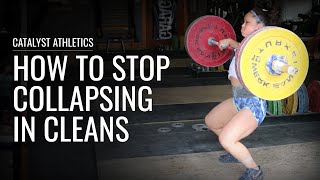
That magnified force is one of the reasons athletes collapse under cleans with weights well under what they can front squat.
And this is why it’s important to include squats using the bounce for a good portion of your training—specifically front squats.
This is how you develop the kind of trunk and postural strength needed to resist the maximal downward force you’re going to be fighting in heavy cleans.
Plus you’ll be better conditioning your joints to manage that stress, and training the timing and aggressiveness of the motion to make it as effective as possible.
Generally, I like front squats to be done with a bounce and back squats to be more controlled through the bottom.
Back squats are a good opportunity to really train leg strength from the smallest knee angle, which helps not just squats, but your ability to pull from the floor with correct posture.
Back squats also have much less of a trunk stability demand, so bouncing is not doing much to help that side of it anyway.
Front squats are an opportunity to train optimal position, timing and aggression for receiving and recovering from cleans, and because of the forward bar position, they’re training trunk and postural strength to a significant degree.
Pause front squats are a great exercise though—don’t skip them. And make sure you’re doing all squat variations at some point from pause, to slow-eccentric, to partial, to pin.
But they lack a really important function—training the ability to bounce out of the bottom that we need in heavy cleans.
Pausing in a squat reduces the downward force you’re resisting to barely over the actual weight on the bar; with something like a clean where you’re hitting the bottom with a lot of speed, you’re having to resist far more downward force.
That magnified force is one of the reasons athletes collapse under cleans with weights well under what they can front squat.
And this is why it’s important to include squats using the bounce for a good portion of your training—specifically front squats.
This is how you develop the kind of trunk and postural strength needed to resist the maximal downward force you’re going to be fighting in heavy cleans.
Plus you’ll be better conditioning your joints to manage that stress, and training the timing and aggressiveness of the motion to make it as effective as possible.
Generally, I like front squats to be done with a bounce and back squats to be more controlled through the bottom.
Back squats are a good opportunity to really train leg strength from the smallest knee angle, which helps not just squats, but your ability to pull from the floor with correct posture.
Back squats also have much less of a trunk stability demand, so bouncing is not doing much to help that side of it anyway.
Front squats are an opportunity to train optimal position, timing and aggression for receiving and recovering from cleans, and because of the forward bar position, they’re training trunk and postural strength to a significant degree.
Pause front squats are a great exercise though—don’t skip them. And make sure you’re doing all squat variations at some point from pause, to slow-eccentric, to partial, to pin.