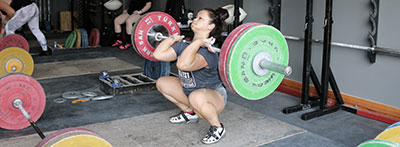



Do you find that your feet never quite end up where they need to be when you snatch or clean? For example, they're always too far behind you? Try actively lifting your feet and stomping them flat on the platform, focusing on landing on the whole foot, not the balls of the feet, and directly under the bar. You might be surprised how much it improves your balance and position when receiving the lift.
Now before you go and tattle on me, I'm not telling you to lift your feet way up into the air. I'm saying make them separate from the platform enough that you can replace them flat and aggressively in the correct location. This doesn't require much air space, but it does require you be active and aggressive and precise.
If you have trouble kicking your feet back and landing on the balls of the feet, try thinking of lifting your knees rather than lifting your feet, and of sitting your hips straight down with a vertical torso rather than pulling your hips back after you finish your extension.
Good post. I've talked with a lot of people about this subject. Many new lifters have a tendency to get carried away and start lifting their feet twelve inches in the air during the turnover, like you said. If you take a picture when they're in the middle of a lift, it looks like they're doing a jump-tuck. This isn't the way to go (although Behdad Salimi snatches a little like that). I like the idea of a more moderate jump-and-stomp movement.
Sarah Jones
2 | 2012-09-11
Are there any tips on improving elbow lockout or is that just something you're always going to be stuck with? My lockout isn't great and I'm wondering if there's anything that can be done to assist, even in a small way. I've heard things about it being linked to tight biceps, is that true? Thank you.
Greg Everett
3 | 2012-09-12
If you have an actual anatomical limitation, there isn't really much you can do. If you can't extend your elbow completely with your arm at your side, you may have an anatomical issue with the joint itself.
Otherwise, you can have lockout trouble for numerous reasons, some of which have to do with inflexibility, although rarely the biceps. Usually it's the shoulder girdle and thoracic spine and even the ankles and hips causing the problem.
But it can also be an issue of poor structure/technique. This article may give you some ideas.
Leave a Comment
Sign up for our free newsletter to get training tips and stay up to date on Catalyst Athletics AND get a free issue of the Performance Menu journal.
Catalyst Athletics is a USA Weightlifting team of competitive Olympic-style weightlifters. We are currently recruting new lifters and offer sponsorship opportunities.